Showing posts with label PET preforms manufacturers in india. Show all posts

Tuesday, 26 July 2011

PET SPRAY BOTTLES

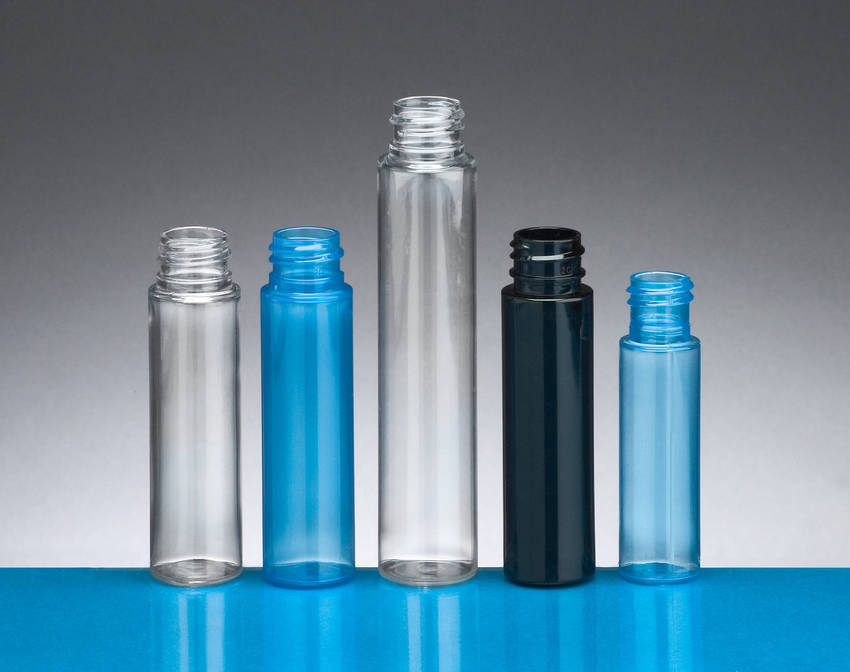
A PET SPRAY BOTTLES is a bottle that can squirt, spray or mist fluids. A common use for pet spray bottles is dispensing cool cleaners, cosmetics, and chemical specialties. Another wide use of pet spray bottles is mixing down concentrates such as pine oil with water. The actual spraybottles web site lists all kinds and sizes of pet spray bottles including custom printed PET SPRAY BOTTLES. The first trigger sprayer manufacturer was named AFA. An interesting note is that there is only one trigger sprayer manufacturer remaining in the US.
Unlike the rubber bulb dispenser which primarily moved air with a small amount of fluid, modern PET preforms manufacturers in india use a positive displacement pump that acts directly on the fluid. The pump draws liquid up a siphon tube from the bottom of the bottle, and the liquid is forced out a nozzle. Depending on the sprayer, the nozzle may or may not be adjustable, so as to select between squirting a stream, aerosolizing a mist, or dispensing a spray.
The dispensing is powered by the user's efforts in a PET SPRAY BOTTLES, as opposed to the spray can, in which the user simply actuates a valve, and product is dispensed under pressure, using a liquid that gasifies at room temperature and pressure such as propane/isobutane blends or Freon, or pressured gasses such as nitrous oxide or ordinary air.

Share/Bookmark

Saturday, 23 July 2011

THERMOPLASTIC POLYMER


Polycarbonates, known by the trademarked names Lexan, Makrolon, Makroclear and others, are a particular group of THERMOPLASTIC POLYMER. They are easily worked, moulded, and thermoformed. Because of these properties, polycarbonates find many applications. Polycarbonates do not have a unique plastic identification code and are identified.
THERMOPLASTIC POLYMER is a very durable material. PET preforms manufacturers in india Although it has high impact-resistance, it has low scratch-resistance and so a hard coating is applied to polycarbonate eyewear lenses and polycarbonate exterior automotive components. The characteristics of polycarbonate are quite like those of polymethyl methacrylate , but polycarbonate is stronger, usable in a wider temperature range but more expensive. This polymer is highly transparent to visible light and has better light transmission characteristics than many kinds of glass.
THERMOPLASTIC POLYMER has a glass transition temperature of about 150 °C (302 °F), so it softens gradually above this point and flows above about 300 °C (572 °F). Tools must be held at high temperatures, generally above 80 °C (176 °F) to make strain- and stress-free products. Low molecular mass grades are easier to mould than higher grades, but their strength is lower as a result. The toughest grades have the highest molecular mass, but are much more difficult to process.

Share/Bookmark

Friday, 22 July 2011

INJECTION MOLDING SYSTEM

INJECTION MOLDING SYSTEM machines consist of a material hopper, an injection ram or screw-type plunger, and a heating unit.They are also known as presses, they hold the molds in which the components are shaped. Presses are rated by tonnage, which expresses the amount of clamping force that the machine can exert. This force keeps the mold closed during the injection process. PET preforms manufacturers in india  Tonnage can vary from less than 5 tons to 6000 tons, with the higher figures used in comparatively few manufacturing operations. The total clamp force needed is determined by the projected area of the part being molded. This projected area is multiplied by a clamp force of from 2 to 8 tons for each square inch of the projected areas. As a rule of thumb, 4 or 5 tons/in2 can be used for most products. If the plastic material is very stiff, it will require more injection pressure to fill the mold, thus more clamp tonnage to hold the mold closed.The required force can also be determined by the material used and the size of the part, larger parts require higher clamping force.
With INJECTION MOLDING SYSTEM, granular plastic is fed by gravity from a hopper into a heated barrel. As the granules are slowly moved forward by a screw-type plunger, the plastic is forced into a heated chamber, where it is melted. As the plunger advances, the melted plastic is forced through a nozzle that rests against the mold, allowing it to enter the mold cavity through a gate and runner system. The mold remains cold so the plastic solidifies almost as soon as the mold is filled.
The plastic INJECTION MOLDING SYSTEM industry has evolved over the years from producing combs and buttons to producing a vast array of products for many industries including automotive, medical, aerospace, consumer products, toys, plumbing, packaging, and construction Molding or moulding is the process of manufacturing by shaping pliable raw material using a rigid frame or model called a pattern.

Share/Bookmark

Wednesday, 20 July 2011

PLASTIC ITEMS

A plastic material is any of a wide range of synthetic or semi-synthetic organic solids used in the manufacture of industrial products. Plastics are typically polymers of high molecular mass, and may contain other substances to improve performance and/or reduce production costs. Monomers of plastic Items are either natural or synthetic organic compounds.
The word plastic is derived from the Greek πλαστικός (plastikos) meaning capable of being shaped or molded, from πλαστός (plastos) meaning molded.It refers to their malleability, or plasticity during PET preforms manufacturers in india, that allows them to be cast, pressed, or extruded into a variety of shapes—such as films, fibers, plates, tubes, bottles, boxes, and much more.
The common word plastic should not be confused with the technical adjective plastic, which is applied to any material which undergoes a permanent change of shape (plastic deformation) when strained beyond a certain point. Aluminum which is stamped or forged, for instance, exhibits plasticity in this sense, but is not plastic in the common sense; in contrast, in their finished forms, some plastics will break before deforming and therefore are not plastic in the technical sense.
There are two types of plastics: thermoplastics and thermosetting polymers. Thermoplastics are the plastics that do not undergo chemical change in their composition when heated and can be moulded again and again; examples are polyethylene, polypropylene, polystyrene, polyvinyl chloride and polytetrafluoroethylene (PTFE).Thermosets can melt and take shape once; after they have solidified, they stay solid.
The raw materials needed to make most plastics come from petroleum and natural gas.
Plastic Items is polluting the oceans. There are an estimated 46,000 pieces of plastic per square kilometre of the world's oceans. Much of it is concentrated in a gyre of marine litter in the central North Pacific Ocean called Great Pacific Garbage Patch, killing a million seabirds and 100,000 marine mammals yearly.

Share/Bookmark

Tuesday, 19 July 2011

PLASTIC PRECISION MOULDS AND DIES


PLASTIC PRECISION MOULDS AND DIES We are an ISO 9001: 2008 certified manufacturer and exporter of Injection Moulding Moulds, Moulded Plastic Products, Plastic Packaging Products and Premium Plastic Household Products.
We at PLASTIC PRECISION MOULDS AND DIES Pvt. Ltd, are engaged in manufacturing and exporting a wide range of injection moulding moulds and injection moulded plastic products. We manufacture all types of cold runner and hold runner moulds for injection moulding. PET preforms manufacturers in india Our range of plastic products include caps & closures, flip top caps, engineering items, packaging products, cream jars, electronic items, medical products, household products and high precision plastic parts. PMD is ISO 9001:2008 certified for design and manufacture of moulds and is also certified for injection moulding of plastic products.
Year of Establishment 1973 Legal Status of Firm Proprietorship Firm Turnover
New Items Product Design Mould Design Mould Manufacturing & Repair Hot Runner Mould Collapsing Core Mould Plastic Containers Plastic Tumblers Plastic Plates Plastic Hangers Plastic Bottle .
There has been evidence found suggesting that Egyptians and Babylonians blew plastic materials[citation needed], but Enoch Ferngren and William Kopitke were the first verified people who used the Blow Molding Process. The process principle comes from the idea of blowing glass.

Share/Bookmark

Monday, 18 July 2011

POLYETHELENE TEREPHTHALATE BOTTLES


polyethylene terephthalate bottles(PET) is one of the most commonly used food grade packaging plastics due to it's chemical inertness and appealing physical properties. as with most plastics PET is derived from oil and is formed by a polymerisation reaction between an acid and an alcohol. its initial uses were as a synthetic fibre with excellent wash and wear properties as well as a substrate for video, photographic and x-ray film. as its use grew PET preforms manufacturers in india was modified for application in injection moulded and extruded products, and in the early 1970's the first three dimensional structures were produced by blow moulding techniques, initiating the rapid adoption of PET as a material for beverage bottles. Its properties as a lightweight, tough material with excellent optical properties and adequate gas barrier performance for the retention of PET bottles are manufactured by the process of injection stretch blow moulding (read more at http://www.bpf.co.uk) which was developed specifically to maximise the beneficial properties of PET.
The majority of the world's PET production is for synthetic fibers (in excess of 60%) with bottle production accounting for around 30% of global demand. In discussing textile applications, PET is generally referred to as simply "polyester" while "PET" is used most often to refer to packaging applications. The polyester industry makes up about 18% of world polymer production and is third after polyethylene (PE) and polypropylene (PP).

Share/Bookmark

Saturday, 16 July 2011

PET PLASTICS EXTRUSION


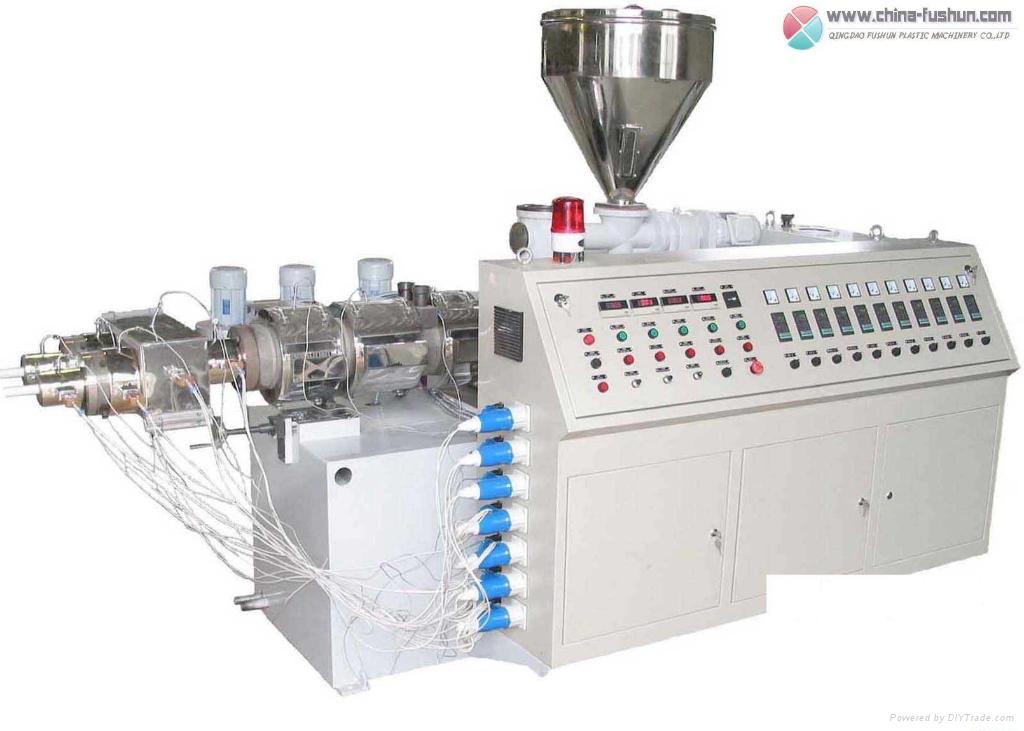
PET Plastics extrusion is a high volume manufacturing process in which raw plastic material is melted and formed into a continuous profile. PET plastic extrusion produces items such as pipe/tubing, weather stripping, fence, deck railing, window frames, adhesive tape and wire insulation.
In the extrusion of plastics, raw thermoplastic material in the form of small beads is gravity fed from a top mounted hopper into the barrel of the extruder. Additives such as colorants and UV inhibitors are often used and can be mixed into the resin prior to arriving at the hopper.
Extrusion coating is using a blown or cast film process to coat an additional layer onto an existing rollstock of paper, foil or film. PET preforms manufacturers in india this process can be used to improve the characteristics of paper by coating it with polyethylene to make it more resistant to water. The extruded layer can also be used as an adhesive to bring two other materials together. A famous product that uses this technology is tetrapak.
Feed zone. Also called solids conveying. This zone feeds the resin into the extruder, and the channel depth is usually the same throughout the zone.
Melting zone. Also called the transition or compression zone. Most of the resin is melted in this section, and the channel depth gets progressively smaller.
Metering zone. Also called melt conveying. This zone, in which channel depth is again the same throughout the zone, melts the last particles and mixes to a uniform temperature and composition.


Share/Bookmark

Friday, 15 July 2011

PLASTIC INJECTION MOLDING


Plastic injection molding is a manufacturing process for producing parts from both thermoplastic and thermosetting plastic materials. Material is fed into a heated barrel, mixed, and forced into a mold cavity where it cools and hardens to the configuration of the mold cavity.[1] After a product is designed, usually by an industrial designer or an engineer, molds are made by a moldmaker (or toolmaker) from metal, usually either steel or aluminum, and precision-machined to form the features of the desired part. Injection molding is widely used for manufacturing a variety of parts, from the smallest component to entire body panels of cars.
An Injection molding machine, also known as an injection press, is a machine for manufacturing plastic products by the PLASTIC INJECTION MOLDING process. It consists of two main parts, an injection unit and a clamping unit.
Injection molding machines can fasten the molds in either a horizontal or vertical position.PET preforms manufacturers in india The majority of machines are horizontally oriented, but vertical machines are used in some niche applications such as insert molding, allowing the machine to take advantage of gravity. There are many ways to fasten the tools to the platens, the most common being manual clamps  however hydraulic clamps and magnetic clamps are also used. The magnetic and hydraulic clamps are used where fast tool changes are required.
The sequence of events during the injection mold of a plastic part is called the injection molding cycle. The cycle begins when the mold closes, followed by the injection of the polymer into the mold cavity. Once the cavity is filled, a holding pressure is maintained to compensate for material shrinkage. In the next step, the screw turns, feeding the next shot to the front screw.This causes the screw to retract as the next shot is prepared. Once the part is sufficiently cool, the mold opens and the part is ejected.

Share/Bookmark

Thursday, 14 July 2011

PET PLASTIC PACKAGING


PET PLASTIC PACKAGING is the science, art, and technology of enclosing or protecting products for distribution, storage, sale, and use. Packaging also refers to the process of design, evaluation, and production of packages. Packaging can be described as a coordinated system of preparing goods for transport, warehousing, logistics, sale, and end use. PET PLASTIC PACKAGING contains, protects, preserves, transports, informs, and sells. In many countries it is fully integrated into government, business, institutional, industrial, and personal use.
Packaging may be described in relation to the type of PET preforms manufacturers in india product being packaged: medical device packaging, bulk chemical packaging, over-the-counter drug packaging, retail food packaging, military materiel packaging, pharmaceutical packaging, etc.
* Primary packaging is the material that first envelops the product and holds it. This usually is the smallest unit of distribution or use and is the package which is in direct contact with the contents.
* Secondary packaging is outside the primary packaging, perhaps used to group primary packages together.
* Tertiary packaging is used for bulk handling, warehouse storage and transport shipping. The most common form is a palletized unit load that packs tightly into containers.

Share/Bookmark

Wednesday, 13 July 2011

PET-PELLETS FOR BOTTLES AND A-PET

This process is, in principle, similar to the one described above; however, the pellets produced are directly (continuously or discontinuously) crystallized and then subjected to a solid-state polycondensation (SSP) in a tumbling drier or a vertical tube reactor. During this processing step, the corresponding intrinsic viscosity of 0.80 – 0.085 dℓ/g is rebuild again and, at the same time, the acetaldehyde content is reduced to < 1 ppm.
The fact that some machine manufacturers and line builders in Europe and USA make efforts to offer independent recycling processes, e.g. the so called PET-PELLETS FOR BOTTLES AND A-PET bottle-to-bottle(B-2-B) process, such as URRC or BÜHLER, aims at generally furnishing proof of the "existence" of the required extraction residues and of the removal of model contaminants according to FDA applying the so called challenge test, PET preforms manufacturers in india is necessary for the application of the treated polyester in the food sector. Besides this process approval it is nevertheless necessary that any user of such processes has to constantly check the FDA-limits for the raw materials manufactured by himself for his process.

Share/Bookmark

Wednesday, 29 June 2011

BIO BASED PET


Bioplastics or organic plastics are a form of plastics derived from renewable biomass sources, such as vegetable oil, corn starch, pea starch,or microbiota,rather than fossil-fuel plastics which are derived from petroleum. Some, but not all, bioplastics are designed to biodegrade
Biodegradable BIO BASED PET preforms manufacturers in india  are used for disposable items, such as packaging and catering items (crockery, cutlery, pots, bowls, straws). Biodegradable BIO BASED plastics are also often used for organic waste bags, where they can be composted together with the food or green waste. Some trays and containers for fruit, vegetables, eggs and meat, bottles for soft drinks and dairy products and blister foils for fruit and vegetables are manufactured from bioplastics.
Nondisposable applications include mobile phone casings, carpet fibres, and car interiors, fuel line and plastic pipe applications, and new electroactive bioplastics are being developed that can be used to carry electrical current. In these areas, the goal is not biodegradability, but to create items from sustainable resources.

Share/Bookmark

Monday, 20 June 2011

STRETCH BLOW MOLDING


In the STRETCH BLOW MOLDING process, the plastic is first molded into a "preform" using the injection molding process. These preforms are produced with the necks of the bottles, including threads on one end. These preforms are packaged, and fed later (after cooling) into a reheat stretch blow molding machine. In the SBM process, the preforms are heated above their glass transition temperature, then blown using high pressure air into bottles using metal blow molds. Usually the preform is stretched with a core rod as part of the process. In the single-stage process both preform manufacture and bottle blowing are performed in the same machine. The stretching of some polymers, such as PET preforms manufacturers in india results in strain hardening of the resin, allowing the bottles to resist deforming under the pressures formed by carbonated beverages, which typically approach 60 psi.PET preforms manufacturers main applications are bottles, jars and other containers.

Advantages of blow molding include: low tool and die cost; fast production rates; ability to mold complex part; produces recyclable parts.

Share/Bookmark

Thursday, 16 June 2011

A PET BOTTELS


This article is about A PET BOTTELS bottles in general. For baby bottles, see Baby bottle.
Composite body, painted, and glazed bottle. Dated 16th century. From Iran. New York Metropolitan Museum of Art.
PET preforms manufacturers in india ding-ware porcelain bottle (far left) with iron-tinted pigment under a transparent colorless glaze, 11th century, Song Dynasty

A PET preforms manufacturers bottle is a rigid container with a neck that is narrower than the body and a "mouth". By contrast, a jar has a relatively large mouth or opening. A PET BOTTELS Bottles are often made of glass, clay, plastic, aluminum or other impervious materials, and typically used to store liquids such as water, milk, soft drinks, beer, wine, cooking oil, medicine, shampoo, ink, and chemicals. A device applied in the bottling line to seal the mouth of a bottle is termed an external bottle cap, closure, or internal stopper. A bottle can also be sealed by a conductive "innerseal" by using induction sealing.A PET BOTTELS has developed over millennia of use, with some of the earliest examples appearing in China, Phoenicia, Rome and Crete.

Share/Bookmark